
By Team #4: The Aviatrix Avengers – Angela & Allison
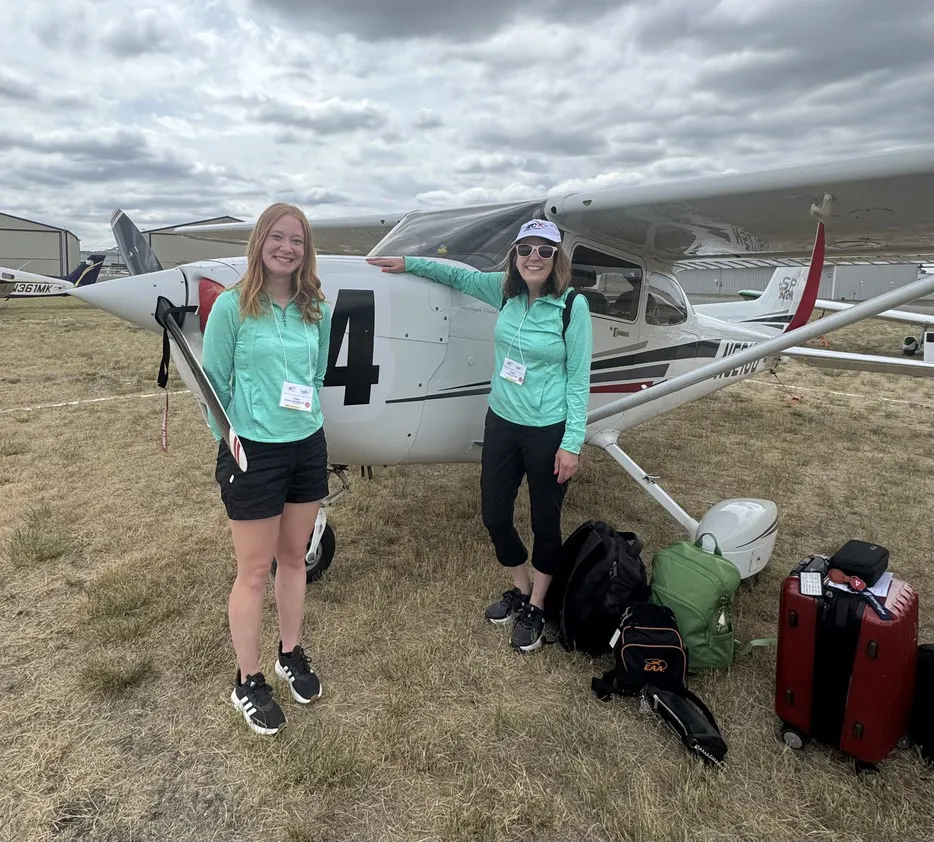
Allison and Angela, Team #4, the Aviatrix Avengers. Final stop for the air race, Felts Field – Spokane, Washington.
Flying in the 2025 Air Race Classic was an experience we’ll never forget. As Team #4, “The Aviatrix Avengers,” we set out from Oklahoma full of excitement and determination for our first Air Race Classic. Over the course of this all-women cross-country air race, we flew more than 3,363 miles—starting at our home airport in Norman, Oklahoma and continuing to the start of the air race in Fairhope, Alabama, and crossing through multiple time zones and breathtaking landscapes before reaching the finish line at Felts Field in Spokane, Washington.
This was a series of firsts for both of us: our first time flying in the mountains, our first time competing in a national aviation event, and our first time seeing so much of the country from the cockpit of the Cessna Skyhawk 172SP. Along the way, we gained not only skill, but also lifelong friendships with fellow aviators who share the same passion for flight.
As two adventurous and determined pilots from Oklahoma, we flew with focus and purpose. Our main goal was to just have fun and enjoy the journey, as well as meet some other air racers from all over the country.
What made this journey truly special was the teamwork. From weather planning to fuel stops, to navigating unfamiliar airports, we relied on each other every step of the way. The Air Race Classic challenged us, inspired us, and reminded us why we fly.
We already can’t wait to do it again in 2026. Until then, follow our aviation adventures online!
For photos and more updates, visit our Facebook page and Instagram.
https://www.facebook.com/aviatrixavengers
https://www.instagram.com/aviatrixavengers
Team #4 – The Aviatrix Avengers
Fair skies and tailwinds!
How we became ‘Racer #4’
On February 4th, 2025, the ‘Top 10’ team number drawing was for early registrants for this years 2025 Air Race Classic. Our team, the ‘Aviatrix Avengers’ was drawn as lucky #4!
History of Air Racing
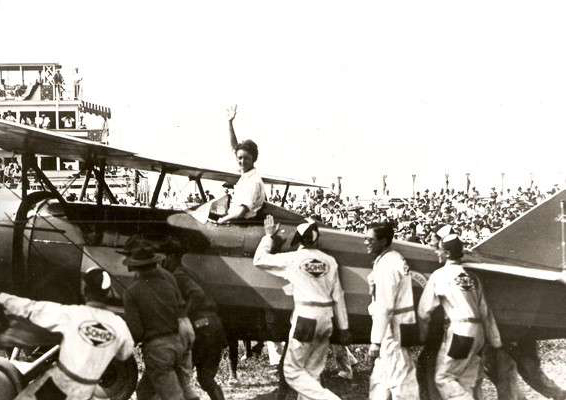 Women’s air racing started in 1929 with the Women’s Air Derby. Twenty pilots raced from Santa Monica, CA to Cleveland, OH, site of the National Air Races. Racing continued through the ’30’s and was renewed again after WWII when the All Women’s Transcontinental Air Race (AWTAR), better known as the Powder Puff Derby, came into being in 1947. The AWTAR held its 30th, final and commemorative flight in 1977. When the AWTAR was discontinued, the Air Race Classic, Ltd. (ARC) stepped in to continue the tradition of transcontinental speed competition for women pilots and staged its premier race.
The Air Race Classic was reincorporated in 2002 into the Air Race Classic, Inc., a non-profit 501(c)(3) educational organization. The ARC encourages and educates current and future women pilots while preserving and promoting the tradition of pioneering women in aviation.
The early air races were the “on to” type, with noon and night control stops, and the contestants more or less stayed together. In that manner, weather and flying conditions were practically the same for each entrant and the race officials could release standings to the media after each day of racing.
The current race routes are approximately 2,400 statute miles in length, and the contestants are given four days, flying VFR in daylight hours, to reach the terminus. Each airplane is assigned a handicap speed – and the goal is to have the actual ground speed be as far over the handicap speed as possible. The pilots are thus given the leeway to play the elements, holding out for better weather, winds, etc. The objective is to fly the “perfect” cross-country. In this type of race, the official standings cannot be released until the final entrant has crossed the finish line. Actually, the last arrival can be the winner.
The races in the 1930s flew shorter legs and made more stops than the current races. Races in the 1980s through 2000 flew longer legs of 350 to 400 miles. Now the legs are 280 to 320 statute miles, with between seven and nine control stops designated for either landing or flyby for timing. The races are open to all women with fixed wing airplanes from 100 to 570 horsepower. The earliest races were flown solo, in the single or two seat airplanes available at that time. Today a team consists of a pilot and copilot, with additional teammates to spread out the workload and add to the fun.
Scoring techniques evolved over the years. In earlier days, the fastest airplane with no specified handicap was in a good position to win, if it held together over the long haul and there was no big navigational error committed. In 1952 the AWTAR began using the handicap system of scoring – each airplane flying against the best speed for that make and model of airplane. The Air Race Classic continued to use this type of scoring, until methods were developed to compute a handicap that is specific to each individual airplane. The goal is for each team to have an equal chance of victory, depending on the accuracy of the handicapping. All participants are true winners in their own right, flying the best possible race.
Regarding awards, the Air Race Classic started in 1977 with an $8,550 purse for the top-ten crews, with additional leg prizes for those finishing outside the selected group of ten. The awards have been increased over the years, so that the current top-ten purse is $20,500 in cash prizes and awards from sponsors.
At a time when some people are inclined to down-play and have only negative views of general aviation, it is encouraging each summer when dozens of women pilots get into their airplanes and safely race each other over trans-continental routings. There is a spirit of camaraderie in spite of the keen competition, and the Air Race Classic proves a boon to aviation in general. At the same time, it gives the racers the opportunity to hone their flying techniques. Many other people are drawn into the annual events through sponsorship, ground/air assistance, timing, officiating and as spectators.
Flying fast and strong today, the Air Race Classic is attracting world-wide success and remains a venue for competitive flying. Louise Thaden is quoted as saying, “… added skills are developed, self-confidence is increased and enduring friendships are made”. And Blanche Noyes added, “Flying is ageless.”
History courtesy of Glenn H. Buffington and Carolyn J. Van Newkirk, Ed.D.
Resource: Air Race Classic